



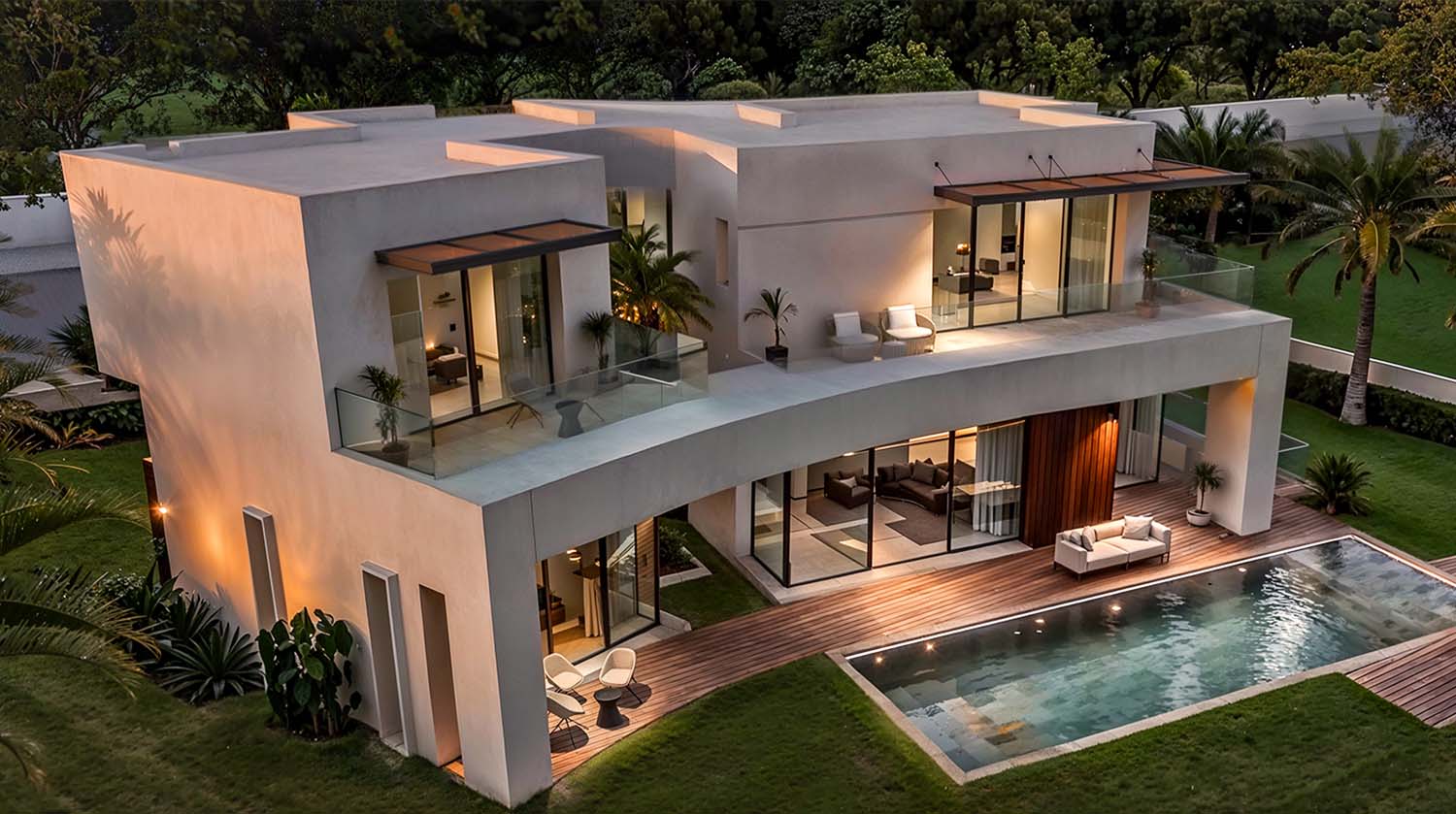
Marrakech is no longer just the “ochre city” of city-breaks and riad weekends. Over the past fifteen years, it has established itself as one of Morocco's key upscale real estate territories: prestigious villas in the Palmeraie, contemporary apartments in Guéliz, renovated riads in the medina, gated residences on the roads to Ourika or Fès. Behind the images of infinity pools and shady patios, a structured market has emerged, with its own codes, players... and above all, new buyer profiles.
Luxury real estate in Marrakech is no longer just for a few insiders or a discreet elite. Today, wealthy Moroccans living abroad, European families, digital entrepreneurs and investors from the Gulf all have very different expectations of the city: quality of life, security, profitability, but also meaning, flexibility and remote support.
These new buyers aren't just looking for a “nice villa with a pool”. They are looking for a lifestyle, a coherent geographical location (neighborhood, accessibility, schools, golf courses, services), a precise level of finish, solid legal guarantees and, for some, a real asset capable of generating rental income or reselling well in the medium term.
Behind every signing of a compromis lies much more than just a transaction. Buying a luxury villa in Marrakech, an exceptional riad or a gated residence means balancing pleasure, family use, professional projection and wealth strategy. That's what this article is all about: who these new buyers are, what they're really looking for, and how to secure their projects in a market that's reaching full maturity.
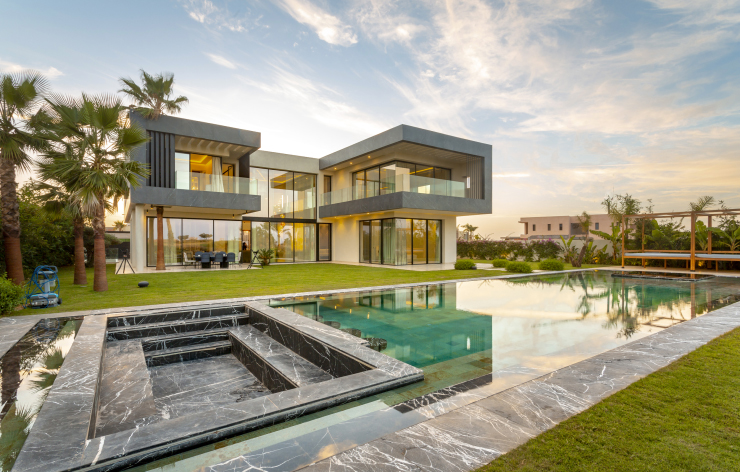
Marrakech, a major scene for luxury real estate
Marrakech's central position on the luxury real estate map in Morocco is no accident. The city combines a number of advantages that are rarely found together: a sunny climate for most of the year, easy access by air to many European capitals, a strong cultural heritage, a top-of-the-range hotel offer and a lifestyle that blends tradition and modernity.
On the real estate front, this attractiveness has translated into a gradual move upmarket: a proliferation of luxury Marrakech villas with large plots, swimming pools and views of the Atlas Mountains, renovation of historic riads transformed into family homes or guest houses, development of secure residences close to golf courses and main roads. The Palmeraie, the Hivernage, Bab Atlas, the golf course fronts and certain outlying roads are now home to a large number of exceptional properties.
This trend is no longer just a passing fad. Numerous specialized Moroccan and international players have positioned themselves in the luxury niche of real estate in Marrakech, With a structured offering, products designed for an international clientele, and quality standards that are increasingly similar to those found in other luxury destinations. The result is a clearer, more segmented market, with a clear distinction between high-end principal residences, luxury second homes, prestige rental investments and exceptional properties for events.
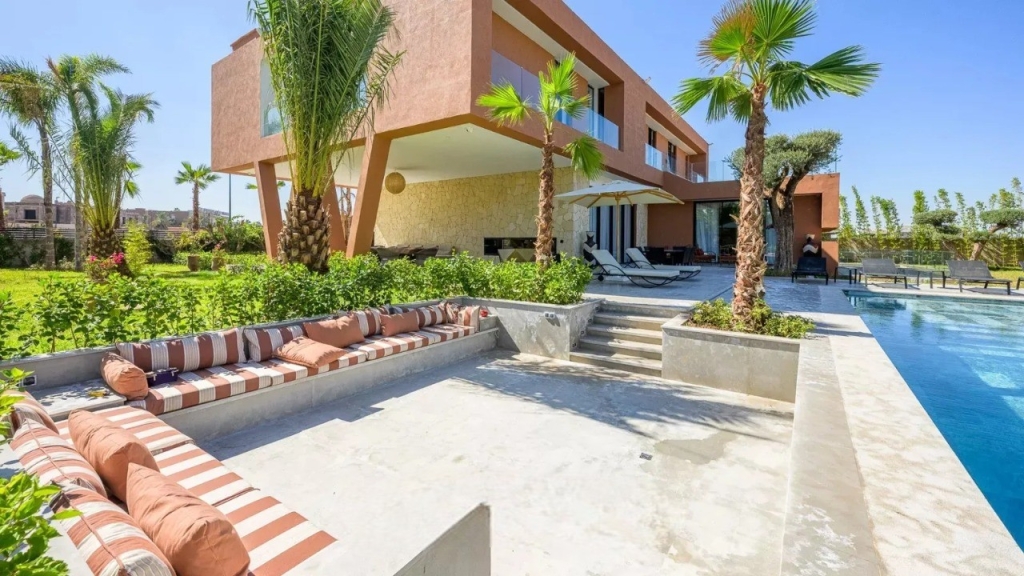
Who are the new buyers of luxury real estate in Marrakech?
The Moroccan diaspora and wealthy Moroccans living abroad
Among the major players in this market, the Moroccan diaspora occupies a central position. Many Moroccans living abroad, whether in Europe, North America or the Gulf States, see Marrakech as having a dual attachment: emotional and patrimonial. For these people, buying a prestigious property in the Ochre city often means reconnecting with their homeland, offering a family reunion point and securing part of their capital in property.
Their motivation is not limited to “returning to their roots”. These buyers, often senior executives, entrepreneurs or professionals, are looking for a luxury villa in Marrakech or a top-of-the-range apartment in a well-serviced area with good schools, an active social life and the possibility of visiting several times a year. Many buy from a distance, multiplying exchanges by videoconference, virtual visits and local contacts (notaries, advisors, agents, family).
This distance creates a strong need for trust and transparency. Planning work, meeting deadlines, land titles, urban planning compliance, quality of finish: everything needs to be documented, proven and traced. Wealthy MREs accept the price, but refuse opacity.
Europeans in search of sunshine and meaning
Another well-established profile is that of Europeans looking for a balance between quality of life, a mild climate and accessibility. French, Belgians, Swiss, Spaniards and Britons see Marrakech as a credible alternative to classic Mediterranean destinations. Two to three hours' flight time, a reduced time difference, a still-competitive cost of living and a growing range of healthcare, education and services.
For these buyers, the traditional vacation home often gives way to a more hybrid project: luxury second home used several months a year, preparation for a retirement in the sun, seasonal or semi-seasonal rental investment, or even partial telecommuting. They are looking for a property where they can welcome family and friends, but also generate income when the property is not occupied.
Their view of luxury real estate in Marrakech is influenced by their European frame of reference. They compare prices per square meter, building standards, insulation quality and documentary transparency. Many are reassured by the presence of structured neighborhoods (Guéliz, Hivernage, Agdal, Palmeraie) and by the possibility of surrounding themselves with specialized advice (lawyers, tax specialists, rental managers).
Buyers from the Gulf and other international fortunes
For several years now, Marrakech has also been attracting customers from the Gulf States and, more broadly, from the world's major metropolises. These buyers are looking for exceptional properties: vast landscaped plots, contemporary villas or palaces inspired by Moroccan architecture, with a high level of private services (staff, security, spa, gym, reception areas).
For this clientele, the choice criteria go beyond the simple residential dimension. It's about buying a “place to live” capable of hosting extended family stays, private events and informal business meetings. Discretion, privacy and security are central: controlled access, few neighbours, trusted staff, reasonable proximity to main roads without exposure to urban density.
These buyers are not necessarily subject to the same budgetary trade-offs as other segments, but they remain attentive to the quality of amenities, the image of the area and the possibility of long-term value enhancement, particularly in emblematic areas such as the Palmeraie or certain golf fronts.
Morocco's business elite
High-end real estate in Marrakech is also favored by the Moroccan business elite: entrepreneurs, group leaders, professionals and senior executives. For them, Marrakech is a refuge, a place to socialize and sometimes an extension of their professional activities.
These buyers often already have a main residence in Casablanca, Rabat or Tangier. The Marrakech villa then becomes a place for weekends, school vacations, private receptions or corporate events. They prefer well-identified neighborhoods (Hivernage, Agdal, Palmeraie, golf courses), secure gated residences or independent villas with good accessibility.
Their requirements focus on construction quality, legal stability and the ability of the property to retain its value over time. They are generally well-informed, compare at length and do not hesitate to involve architects, decorators and design offices to audit a project before acquisition.
New hybrid profiles: digital nomads, entrepreneurs, techies
The latest emerging profile: younger buyers, often from the tech ecosystem, digital entrepreneurship or the creative professions. They don't always fit the classic image of the “prestige property” owner, but have the income or liquidity to consider buying a high-end property, sometimes as a co-investment.
These profiles are looking less for a status symbol than for a hybrid living space: a place to work and create, a home for entertaining friends and partners, a fallback base for traveling, sometimes even a mini-hub for organizing retreats, workshops or seminars. They are very sensitive to contemporary design, large bay windows, open spaces and connectivity (high-performance Internet, office space, home automation).
Their budgets may vary, but their expectations in terms of overall experience are high. They are demanding when it comes to the quality of finishes, the coherence of the floor plan, luminosity, landscape integration and, often, the possibility of combining personal use with targeted rental exploitation (work stays, creative retreats, long-term stays).
What these buyers are really looking for
Living environment and location
Beyond architectural style, the first criterion for choosing a property is its living environment. In Marrakech, each area tells a different story. The medina offers an immersion in traditional urbanity, with its narrow streets, patios and panoramic terraces. Guéliz and Hivernage offer a more urban environment, with shops, restaurants and modern infrastructure. The Palmeraie and outlying roads (Ourika, Fès, Amizmiz...) offer space, greenery and views of the Atlas Mountains.
Buyers choose between peace and accessibility. Some accept being 20 or 30 minutes from the center to benefit from a large plot, unobstructed views and greater privacy. Others prefer a more central location, even if it means downsizing, to facilitate commuting, access to schools or running a business.
Families look closely at proximity to international schools, clinics, shopping centers and airport exits. Rental investors, on the other hand, evaluate ease of access for tenants, the neighborhood's reputation on reservation platforms and the seasonality of demand.
Contemporary villa, riad or gated community?
The choice of property type is another strong marker. The contemporary Marrakech luxury villa, often located on the outskirts of town or in areas such as the Palmeraie or the golf courses, seduces with its generous volumes, modern comfort, large bay windows and structured outdoor spaces (terraces, pool house, landscaped gardens). This is the most popular format for families seeking regular use and privacy.
The luxury riad, on the other hand, follows a different logic. Set in the heart of the medina or historic districts, they offer a more intimate experience, centered on the patio, terraces and artisanal details. They are particularly appealing to lovers of traditional architecture, aesthetes and certain investors who see the potential for a guest house or seasonal rental with high added value.
Finally, gated residences offer a compromise: 24/7 security, shared services (gardens, pools, sometimes a clubhouse or spa), simplified management, and a community of residents often made up of families and retirees. This format reassures foreign buyers or those who do not occupy the property continuously, as it limits the constraints of day-to-day management.
Comfort, finish and service
While certain images of luxury remain unavoidable (swimming pool, garden, fine materials), new buyers go much further in their analysis of comfort. They look at brightness, orientation, circulation between spaces, quality of materials, thermal and sound insulation, ventilation and ease of maintenance.
The finishing touches are scrutinized: joinery, kitchen equipment, bathrooms, air conditioning and heating systems, home automation. In top-of-the-range real estate in Marrakech, the presence of a hammam, spa, gym, home cinema or well-designed office can make all the difference. Buyers know that these features determine both their personal comfort and the attractiveness of the property when it comes time to rent it out.
Services complete the picture: concierge, house staff, gardener, pool attendant, technical maintenance, security. Some buyers prefer structures where these services are professionally organized (property manager, facility management company) rather than relying solely on informal arrangements.
Transparency, legal certainty and support
For a significant proportion of buyers - particularly foreigners, MREs and long-distance residents - legal certainty is a non-negotiable criterion. They expect clear documents: well-established land titles, urban planning compliance, building permits, acceptance reports, detailed reservation contracts, ten-year warranties where applicable.
Transparency is also required in terms of delivery times, payment terms and the identity of all parties involved (developer, architect, general contractor, subcontractors). Buyers are looking for people who can explain the legal framework, clarify basic tax issues and propose solutions for structuring their acquisition (purchase in their own name, company, joint ownership, etc.).
Promoters, agencies and consultants who take the time to document each step, provide regular reports and answer legal, technical and tax questions with precision, clearly gain credibility with this new clientele.
Rental potential and value enhancement
A growing number of buyers are interested in the rental potential of their luxury property. They're not always looking for maximum yield, but want their prestige property to be able to generate additional income or, at the very least, cover part of the maintenance costs when it's not occupied.
They therefore analyze rental demand according to property type (detached villa, riad, apartment), capacity, location (proximity to the medina, golf courses, tourist attractions), seasonality and competition. Properties suitable for families, groups of friends or private events are often specifically positioned in the high-end rental market.
Beyond rental, the question of future resale weighs heavily in the decision. The image of the area, the quality of construction, the rarity of the product, the medium-term prospects for urban development, the good condition of co-ownerships: these are all factors that structure the potential value of a real estate asset in Marrakech.
Buying from abroad: how do these buyers secure their project?
Buying a luxury villa or riad from a distance remains a delicate exercise. For many buyers, the distance is a source of legitimate fears: fear of choosing the wrong neighborhood, underestimating the work involved, misinterpreting the plans, not mastering local legal specificities or finding themselves faced with broken promises.
Most of them adopt a multi-stage approach. First, they scout out the area: online research, discussions with existing owners, consulting specialized agencies, analyzing neighborhoods. Then there are trips to the site, sometimes of short duration, to visit as many properties as possible, get a feel for the neighborhoods, test commute times, and interview several people (agents, notaries, developers, architects).
Once the project has been targeted, these buyers multiply the guarantees: they request legal documents, seek advice from notaries, use specialized lawyers or advisors, consult engineers or architects to validate the quality of the building, and negotiate contractual clauses on deadlines, penalties and guarantees. The choice of interlocutor - developer, private vendor or agency - becomes as important as the property itself.
The growing role of digital tools
In this context, digital technology plays an increasingly central role. Virtual visits, detailed videos, 3D plans, exchanges via WhatsApp or videoconferencing, regular reports (photos, videos, checklists) help to reduce uncertainty and maintain the link between the buyer and the project.
Beyond these “home-made” tools, a trend is emerging towards more structured solutions: secure platforms where buyers can find all their documents, payment schedules, site schedules, progress reports, support tickets, etc. This digitalization of customer relations is particularly appreciated by MREs and international investors, who sometimes manage several projects remotely. This digitalization of customer relations is particularly appreciated by MREs and international investors, who sometimes manage several projects remotely.
Case study: a worksite monitoring application
Some real estate groups in Marrakech have even developed their own digital monitoring tools. This is the case, for example, of’AMG Building, which offers its customers a dedicated application for monitoring the progress of their project remotely: visualization of worksite stages, photo sharing, validation of certain decisions, centralization of exchanges. This type of solution illustrates the evolution of a market where the customer experience is no longer based solely on final delivery, but on the quality of follow-up throughout the process.
This is not an isolated case: more and more players are looking at how to make the purchasing process more legible, traceable and worry-free, especially for customers who cannot be physically present at every stage.
How to choose a luxury project in Marrakech without being blinded by image?
Faced with the profusion of polished images, perfect 3D renderings and seductive speeches, the central question for the buyer remains: how to keep a cool head? A few simple principles can help structure your approach.
Check the promoter's or seller's references
Before falling in love with a project, it's essential to look at who's behind it. What past achievements? What's their track record in the market? Are previous customers contactable? Are the programs delivered on track in terms of quality and on-time delivery? A serious developer generally has no problem providing verifiable references.
In the case of a private vendor, the stakes are different but just as important: origin of the property, history of work, quality of interventions, existence of authorizations, conformity of any extensions. Here again, it's better to invest time in verifications than to suffer an unpleasant surprise later on.
Visit, compare, put the “coup de coeur” into perspective”
The “coup de coeur” is an integral part of luxury real estate in Marrakech, but it must be part of a structured comparison. Visiting several properties, in different neighborhoods, allows you to appreciate the real trade-offs: surface area vs. location, new vs. existing, garden vs. proximity to services, quietness vs. accessibility.
Comparing also means setting benchmarks: understanding what the market really offers for a given budget, spotting differences in construction quality, identifying properties that are correctly positioned in relation to their surroundings.
Request specific documents
For any luxury Marrakech villa, riad or high-end apartment project, certain documents must be considered non-negotiable:
- clear and up-to-date land title ;
- reliable architectural and technical plans ;
- building permits and planning approvals ;
- acceptance reports (where applicable) ;
- detailed contracts with payment schedules and penalties ;
- any warranties (decennial, biennial, etc.).
The way in which these documents are provided, explained and commented on, often speaks volumes about the seriousness of the interlocutor.
Anticipate maintenance, staff and basic tax costs
An exceptional property implies running costs commensurate with the services it provides: maintenance of the garden, pool and building, staff salaries, security, any condominium charges and energy consumption. Before signing, it's essential to estimate these costs over a full year, taking into account seasonal variations.
Basic tax considerations also need to be factored into the calculation: local taxes, the regime applicable in the case of leasing, possible impacts in the buyer's country of residence. Without aiming for sophisticated optimization, having a clear vision avoids unpleasant surprises.
Surround yourself with independent advice
Finally, a key point: don't be satisfied with just one speech. Cross-checking the opinions of a notary, lawyer, architect or structural engineer helps to verify the overall coherence of the project. In a market where emotion and image play an important role, these independent viewpoints provide a welcome form of rational counterbalance.
Conclusion
The “new buyers” of luxury real estate in Marrakech speak of something much broader than the simple upscaling of a market. They express a quest for quality of life, space and a sense of place, but also for meaning and control. Whether they're MREs, Europeans, local entrepreneurs, international fortunes or hybrid digital profiles, they're all seeking to reconcile pleasure, family use, lifestyle plans and wealth strategy.
In this equation, success depends not only on the property chosen - contemporary villa, characterful riad, gated residence - but just as much on the seriousness of the people involved, the solidity of the legal framework and the transparency of the process. The gradual digitization of the buying process, the rise of remote monitoring tools and the increasing skills of the various players are helping to structure a market where trust is becoming as precious an asset as the stone itself.
When it comes down to it, buying a prestige property in Marrakech means choosing a piece of the city and a way of life - a few weeks a year, several months or full-time. Buyers who take the time to clarify their priorities, surround themselves with the right advice and look beyond the spectacular images are the ones who, in the long term, get the most out of this city that never ceases to reinvent itself.